Hackers Target Blood Storage Refrigeration Systems in France
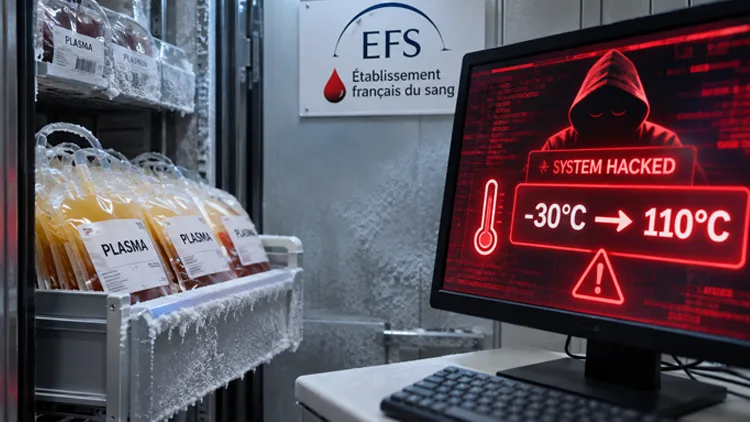
Hackers reportedly manipulated refrigeration systems storing blood plasma in France, changing temperature settings to 110°C. The attack was detected before damage occurred.
Cyberattack in France: Hackers Target Blood Storage Refrigeration Systems
A cyberattack targeting a service provider for the French Blood Establishment (EFS) reportedly allowed hackers to remotely alter the temperatures of cold storage facilities containing blood plasma and biological samples. The incident was detected before any damage occurred, raising serious concerns about the cybersecurity of connected industrial equipment.
Hackers Change Freezer Settings from -30°C to 110°C
During the night of November 1–2, 2026, cybercriminals reportedly targeted refrigeration systems operated by Coolworld, a company providing temperature-controlled storage services to the French Blood Establishment (EFS).
According to information published by French investigative newspaper Le Canard enchaîné on November 3, attackers managed to gain unauthorized access to the control systems of several cold storage units.
The hackers allegedly changed the temperature settings from -30°C to an extreme 110°C.
The affected facilities contained biological samples collected from blood donors, as well as plasma intended for medical transfusions.
Such manipulation could have had serious consequences, potentially destroying sensitive medical products and disrupting essential healthcare operations.
Attack Detected Before Blood Products Were Damaged
Fortunately, employees monitoring the refrigeration facilities quickly noticed the abnormal temperature settings and intervened before the stored products were affected.
According to statements attributed to the French Ministry of Health and EFS, neither the biological samples nor the blood plasma suffered damage.
The incident reportedly caused no operational disruption.
However, several important questions remain unanswered:
- How many refrigeration units were compromised?
- How long did the attackers maintain access to the systems?
- Did the actual temperatures increase, and if so, by how much?
- Which security vulnerability allowed the intrusion?
- Who was responsible for the attack?
Authorities have not publicly identified the perpetrators, and the technical details of the intrusion remain unclear.
A Growing Wave of Cyberattacks Against Refrigeration Systems
The attack comes amid a series of cybersecurity incidents involving connected refrigeration infrastructure across Europe.
Similar attacks have reportedly affected supermarkets and food distribution facilities in France, Belgium, Sweden, and Ireland.
In some cases, cybercriminals allegedly disrupted refrigeration operations, causing temperature fluctuations that compromised the cold chain.
The resulting damage reportedly led to the destruction of food products worth millions of euros.
Swiss supermarket chains, including Coop, have also reportedly experienced attempted attacks against refrigeration infrastructure.
Some incidents were limited to individual locations, while others were detected and stopped before significant damage occurred.
At present, there is no confirmed evidence linking the attack involving EFS to the incidents affecting European supermarkets.
Why Connected Refrigeration Systems Are Vulnerable
Modern industrial refrigeration systems increasingly rely on connected technologies to monitor temperatures, optimize energy consumption, and enable remote maintenance.
These systems are often integrated into industrial control environments, commonly referred to as Operational Technology (OT).
Although remote connectivity improves efficiency, it can also introduce cybersecurity risks when systems are not properly secured.
Potential attack vectors include:
- Exposed remote management interfaces.
- Weak or compromised administrator credentials.
- Outdated industrial control software.
- Insecure network configurations.
- Insufficient separation between IT and OT networks.
- Vulnerabilities in third-party maintenance platforms.
If attackers gain access to refrigeration controllers, they may be able to modify operating parameters, disable alarms, or interrupt cooling processes.
In healthcare environments, such incidents can have consequences extending far beyond financial losses.
Medical laboratories, hospitals, pharmaceuti
Comments (0)
No comment yet. Be the first!